
GenAI ESG Classifier
Automate ESG Data Analysis with AI-Powered Classification
The GenAI ESG Classification system enables customers to automatically classify Environmental, Social, and Governance (ESG) data from diverse sources, including news, reports, and social media at scale. This categorisation system helps organisations assess ESG risks, compliance, and trends in real time, improving decision-making and regulatory adherence.
Powered by Gemini 2.5 Flash Lite, the GenAI ESG Classifier achieves high accuracy, efficiently identifying ESG-related themes and categorizing them into structured outputs for better decision-making and risk management.
Adding to your Dynamic Pipeline
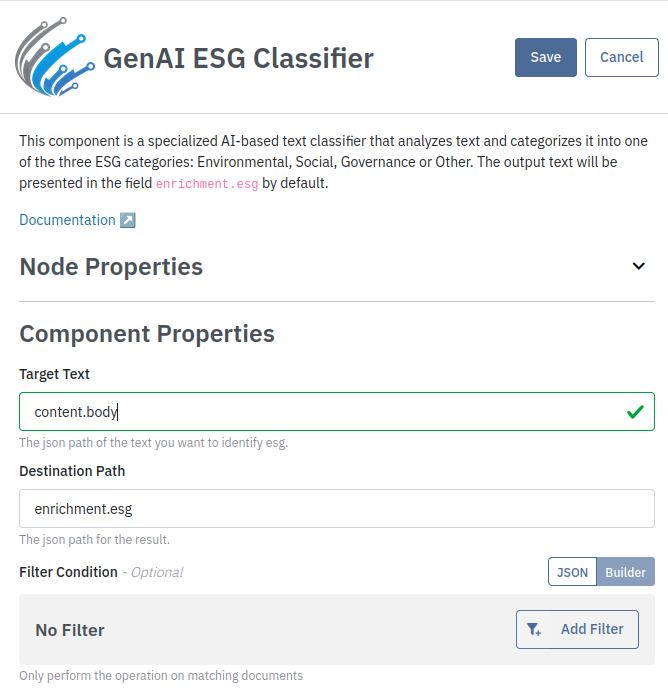
This component can be seamlessly integrated into your Dynamic pipelines through the "GenAI ESG Classifier" component. It requires the following fields for configuration:
Destination Path (Required)
The "enrichment.esg" field is designated to store the ESG output. This output includes an ESG label — one of four possible labels:
- Environmental — Content related to waste management, ecological impact, energy management, and environmental sustainability
- Social — Content related to labour practices, diversity & inclusion, data security, customer privacy, employee engagement, and social welfare
- Governance — Content related to business ethics, regulatory compliance, product lifecycle management, and corporate governance
- Other — Content that does not correspond to any ESG category above Each label includes a confidence score ranging from 0 to 1, reflecting the model's certainty for each ESG theme detected.
Target Text (Required)
This is the metadata field containing the input text for ESG analysis. By default, it's set to content.body, but any field containing relevant text can be used. If the Gemini Model encounters safety issues with certain content, the API will fail to generate output.
Dynamic Pipeline Configuration Example
The following example shows a dynamic pipeline configuration for the GenAI ESG Classifier component. If Unify is the preceding step in your pipeline, you can set it up as follows:
- content.body from the input document is specified as the Target Text for the GenAI ESG Classifier
- enrichment.esg is designated as the Destination Path for storing the GenAI ESG Classifier output
Output example:
"enrichment": {
    "esg": {
        "label": "Environmental",
        "confidence": 0.8
    }
}
Updated 20 days ago